
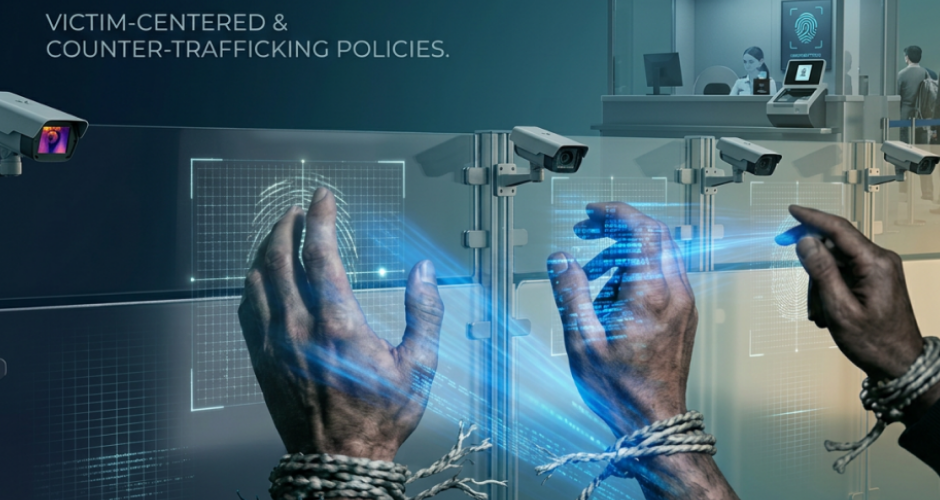
A new policy dossier titled “Policy Dossier on the Western Balkan Route,” published by the Agenfor International Foundation (member of the INTERCEPTED project), in collaboration with the University for Peace (UPEACE), provides empirical evidence that closing legal, transparent channels for migration does not stop human movement. Instead, it systematically weaponises the vulnerability of migrants, forcing them into highly abusive, debt-driven trafficking criminal networks. It also identifies a contradiction between European statistics on detections at external borders and the dynamics observable along the terminal segment of the Wester Balkan route: although these indispensable, they don not coincide with the overall phenomenon.
The dossier identifies a stark contradiction between official European border detection statistics and the real-time dynamics observable along the terminal segments of the Western Balkan route. While border statistics remain indispensable, the report cautions that they capture only a fraction of the situation and do not reflect the true scale of the overall phenomenon.
Furthermore, the report exposes a dangerous hybridization of crime, where traditional smuggling operations are being co-opted by severe Trafficking in Human Beings (THB) networks. By driving migration further underground, current enforcement policies are inadvertently acting as an economic incubator for trafficking syndicates.
With traditional paths blocked, migrants are forced to rely on sophisticated digital smuggling networks operating via encrypted apps (Telegram, Signal) and informal hawala financial systems. When increased border policing causes transit attempts to fail, the fees charged by these networks multiply exponentially.
Once a migrant’s financial resources are completely exhausted, the relationship ceases to be transactional. Smuggling networks transition into trafficking syndicates, exploiting the individual’s legal invisibility. Migrants are subjected to debt bondage, physical violence, and structural coercion, forced to “pay off” their passage through severe labor exploitation, agricultural servitude, or forced sex work within the EU.
The dossier argues that the EU’s focus on deterrence acts as an economic incubator for trafficking rings. By failing to provide accessible legal entry, circular labor visas, and transparent asylum processing, the EU effectively cuts off migrants from legal protection, ensuring they will never report abuse to authorities out of fear of immediate deportation or detention under the new rules.
Recommendations
To combat the rising tide of Human Trafficking, the report argues that the European Union must expand and safeguard legal migration pathways. The absolute most effective anti-trafficking policy is to eliminate the illicit market’s customer base by providing transparent, regulated, and legal alternatives for entry and work.
Additionally, the dossier proposes an innovative, five-step pre-investigative triage model designed to protect victims. This framework allows authorised public agencies and NGOs to securely capture digital footprint data under strict minimization standards. Rather than using data for mass surveillance or undifferentiated criminalization, this model focuses on identifying indicators of coercion, establishing auditable chains of custody, and prioritising victim-centered referrals to rescue individuals from trafficking networks.
This framework aligns with the “do no harm” principle in public-private cooperation when tackling smuggling or THB crimes. Consequently, it guarantees informed consent where appropriate, the protection of vulnerable people, absolute confidentiality, secure storage, and full traceability of information handling, while maintaining a strict separation between fact and inference. This is the exact operational and ethical standard that the INTERCEPTED Project defends throughout its investigations.


